
The NonProfit Center
NonProfit Center is located at 89 South Street, Boston MA 02111
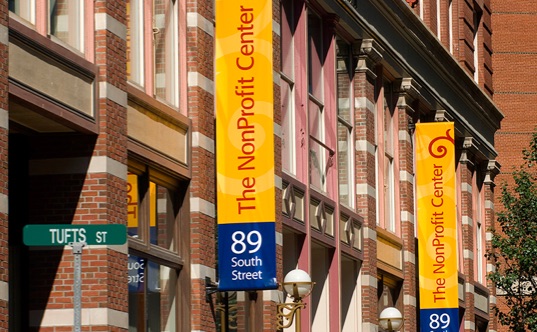
Convene, Connect, Network, and Learn Together
Owned and operated by TSNE, the NonProfit Center is home to more than 50 nonprofits, and welcomes visitors from hundreds of organizations every year. The building is a hub of activity where people come to convene, connect, network, and learn together.
Members of the NonProfit Center in Boston believe that by working together, much more can be achieved with, and for, its members, as well as the larger nonprofit community, and the residents of Greater Boston and beyond. The building fosters a physical and cultural environment that supports the needs of nonprofits.
The First of it’s Kind
The NonProfit Center is the first mission-based, multi-tenant center for nonprofits in Massachusetts. Its office and meeting facilities are available for rental at below-market rates to many nonprofits who would otherwise not be able to afford space in Boston. The building, located at 89 South Street in Boston’s Leather District, is an architecturally distinctive property and is listed on the National Register of Historic Places. It is located just one block from the South Station transportation center, an easy walk to the Massachusetts State House and Boston City Hall, and to the many social and cultural activities nearby.
Our Space
During the renovation of the Nonprofit Center in 2004, TSNE committed to preserving the architectural details that embody the building’s past and developed a vision to restore the building for the future using environmentally preferred materials and design. The building recycles or composts 75%of its waste and uses high-efficiency light and HVAC systems. The NonProfit Center has LEED certification from the U.S. Green Building Council and is ENERGY STAR® certified by the U.S. Environmental Protection Agency.
Our Event and Meeting Spaces
Conveniently located in downtown Boston, the NonProfit Center features rentable meeting and event facilities for nonprofit organizations and mission-based groups. Our four meeting rooms include a newly renovated, state-of-the-art conference center that can accommodate large events or small meeting groups. Our amenities include multimedia equipment and an outdoor courtyard.
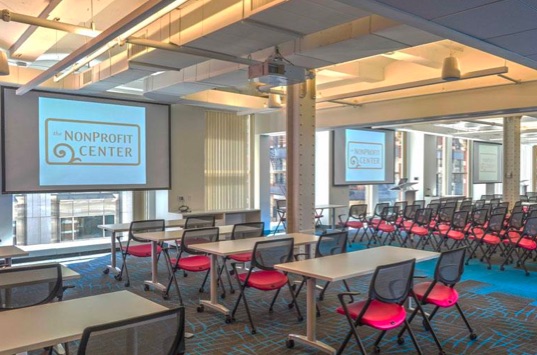
Jonathan Spack Community Conference Center
Our newly renovated, state-of-the-art conference center can accommodate large events or small groups and meetings. The Community Conference Center is named after Jonathan Spack, the visionary behind the building of The NonProfit Center. Jonathan served as Chief Executive Officer of TSNE MissionWorks for over 30 years and during his tenure developed the Center into the vibrant community of nonprofits it is today.
Conference center amenities:
- Theater-style seating for up to 200 guests
- Round table seating for up to 120 guests
- Three screens and ceiling mounted projectors
- Pendulum and ceiling mounted speakers
- Lavalier mics
- User-friendly audio-visual system touch panel
- Wireless internet access
- White boards and markers
- State-of-the-art conference furniture
- Operable partition wall for room division
- Access to a shared kitchen and mini-fridge storage
Pricing:
Conference Center East (80 theater style, 48 table seating)
East Room (1,166 s.f.)
Half-day or evening rentals: $450
Full-day: $650
Conference Center West (140 theater style, 80 table seating)
West Room (2,354 s.f.)
Half-day or evening rentals: $600
Full-day: $800
Full Conference Center Rentals (200 theater style, 120 table seating)
3,250 s.f.
Half-day or evening rentals: $900
Full-day: $1300
Additional Facilities
In addition to our Community Conference Center, the NonProfit Center also has several meeting rooms available on its first floor to accommodate small gatherings.
Facility Information
Wayne Glynn Community Room (75 theater style, 42 table seating)
Half-day or evening rentals: $400
Full-day: $600
Videoconferencing Room (20 table seating)
Half-day or evening rentals: $200
Full-day: $300
Room Rental Time Blocks
Rates are based on half-day rentals (up to 4 hours) or full-day rentals (up to 8 hours).
- Half-day rentals: up to 4 hours beginning at 8:00 a.m.
- Full-day rental: up to 8 hours beginning at 8:00 a.m.
- Evening rental: half-day rate beginning at 6:00 p.m.
- Weekend (Saturday only) rental: 8:00 a.m. to 4:00 p.m.
Please Note
Building and technical assistance services, including room set-up and clean-up, will not be available for evening or weekend rentals. A $50 fee for room set-up may be applied to special room configurations. Reservations will be accepted, subject to room availability, within 48 hours of receipt of a request. Reservations booked on a first-come, first-serve basis. We highly recommend reserving your room at least a month in advance.
The NonProfit Center is located at 89 South Street, Boston MA 02111
Directions and Parking
We’re one block from South Station, a major public transportation hub and close to the intersection of interstate highways I-90 and I-93. The center is accessible through the main lobby to people who have restricted physical abilities.
By Subway
From the Red Line or the Airport/Waterfront section of the Silver Line:
- Exit the train at South Station.
- Follow signs for “commuter rail & bus terminal.”
- When in the main concourse, continue to the far doors (past the food court) and the train platforms.
- When you reach the start of the platforms, take a right. Exit down the stairs to Atlantic Ave.
- Cross at the light onto Essex St., and walk one block. The One Financial tower will be on your right.
- The NonProfit Center is on the corner of Essex and South streets. The entrance is on South Street through the revolving glass doors.
By "T", Commuter Rail, and Amtrak
Exit from the platform onto Atlantic Ave., and follow the directions as via the Red Line above. (Step 4)
From the South Station Bus Terminal: Exit the building, following signs for Commuter Rail/Red Line. Once on the train platform, exit to the left onto Atlantic Ave. and follow directions as via Red Line above. (Step 4)
Driving Directions
From Points South: Take Interstate 93 North to Exit 20. Bear right onto off-ramp at Exit 20 to Frontage Rd (Frontage Road Northbound, New Frontage Road North). Follow signs for South Station, exiting onto Atlantic Avenue. At your second light, turn left onto Essex Street. Turn left onto South Street. The NonProfit Center is at 89 South Street, on your right.
From Points North: Take I-93 South toward Boston. Take the Purchase Street, Exit #23 toward South Station. Continue on Purchase Street. Continue on Surface Road. Take a left onto Essex Street. Take a right onto South Street. The NonProfit Center is at 89 South Street.
From Points West: Take I-90 (Mass Pike) east towards Boston to the Mass Pike Extension. Bear left onto off-ramp at Exit 24 A-B-C, and take Exit 24A to South Station. Drive off the ramp onto Atlantic Avenue. At the second light, turn left onto Essex Street. Take your first left onto South Street. The NonProfit Center is at 89 South Street, on your right.
Parking Options
Parking downtown can be both challenging and expensive, and we recommend taking public transit whenever possible. However, there are several parking lots within walking distance of the NonProfit Center:
- Two Financial Center, 236 Essex Street (1-minute walk)
617.426.1620
Indoor Garage, self-park
Half a block from the Center
Oversize Vehicle surcharge - Central Chinatown Garage, 86 Beach Street (between Lincoln St. & Surface Artery S) (3-minute walk)
617.542.1549
Indoor Garage - LAZ parking, 180 South Street (between Kneeland & Beach Streets) (2-minute walk)
617.426.0604
Indoor Garage, self-park & valet
Oversize Vehicle surcharge may apply - Central Parking – South Station Bus Terminal, 792 Atlantic Ave (Between JFK Expy & Summer Street) (4-minute walk)
Enter via Lincoln St. & South Station Connector
Rooftop parking, self-park
Oversize Vehicle surcharge may apply
In addition, BestParking.com will locate nearby parking lots.